Nicholas Arcolano, Ph.D.
Chief Scientist / Jellyfish
The biggest barrier to AI adoption isn't the technology.
It's measurement, organizational readiness, and knowing what's actually working. I'm a researcher and advisor focused on AI's real-world impact on software engineering.
In my role as Chief Scientist at Jellyfish, my team and I study AI adoption using the largest engineering dataset in the industry: 1,300+ companies and more than 100 million pull requests. We turn what we find into guidance for leaders putting AI into practice.
selected
 talkAI Engineer New York · 2026-10
It's Not the Model, It's You
 podcastAI Native Dev · 2026-06
Why Developers Hit a Wall at 4 AI Agents
 postTessl · 2026-10
There Aren’t Enough Chaperones for All Your Coding Agents
 pressTechCrunch · 2026-06
The Token Bill Comes Due: Inside the Industry Scramble to Manage AI's Runaway Costs
01 / Key Findings
Highlights from my research with Jellyfish, drawn from engineering workflow data across 1,300+ companies, roughly 300,000 engineers, and more than 100 million pull requests.
- Agents are writing more code than teams can trust. At the median company, autonomous coding agents authored 22% of merged PRs (53% at the 90th percentile), but only about 0.6% of PRs were merged by agents without human review. Agent-authored PRs are abandoned at twice the rate of human ones (40% vs. 20%). Tessl, 2026-10
- More PRs aren’t the same as more product. Over 2026, pull requests roughly doubled while product outputs like features shipped rose only about 40–50%. Tessl, 2026-10
- The model barely matters; the engineer matters most. The AI tool itself (model and harness) explains less than 1% of the difference in what engineers ship. AI usage volume explains about 9%, company and team about 12%, and the individual engineer more than 75%. The Daily Context, 2026-10
- Tokenmaxxing hits diminishing returns. The top 10% of Claude Code users consumed about 10x the tokens of the median developer but produced only about 2x the output, and cost per merged PR rose from $0.28 at the lowest adoption tier to $89.32 at the highest. TechRadar Pro, 2026-07
- AI-assisted PRs are bigger. Going from 0% to 100% AI adoption corresponds to about 18% more lines added per pull request. Jellyfish, 2025-09
02 / Writing & Research
I write data-driven research on AI and software engineering. Recent pieces I've authored:
- There Aren’t Enough Chaperones for All Your Coding AgentsTessl · 2026-10
- It's Not the Model, It's YouThe Daily Context (AI Engineer New York) · 2026-10
- Tokens Are Rocket Fuel, Spending Tokens Is Rocket ScienceJellyfish Research · 2026-08
- How to Embrace the Spirit of "Tokenmaxxing" Without Breaking the BankTechRadar Pro · 2026-07
- The State of AI in Software EngineeringJellyfish · 2026-06
show all writing (14 more)
- The Opus 4.7 Tokenizer TaxJellyfish Research · 2026-05
- Teaching Your AI Agent Pays OffJellyfish Research · 2026-04
- Tokenmaxxing and the Agentic BarrierJellyfish Research · 2026-04
- Is "Tokenmaxxing" Cost Effective?Jellyfish · 2026-04
- The AI Divide Is Growing: What 37 Million PRs RevealJellyfish · 2026-04
- Are AI Coding Tools Making Companies More Productive?Jellyfish · 2026-03
- Is AI Finally Taming Bug Backlogs?Jellyfish Research · 2026-02
- Looks Like It Really Was a Claude Christmas After AllJellyfish Research · 2026-02
- AI Is Making Developers Faster — So Where's the Business Impact?Jellyfish · 2026-01
- AI Coding Tools Not Paying Off? Your Code Architecture Might Be to BlameJellyfish · 2025-10
- Better Code, or Just Bigger? AI-Assisted PRs Are 18% LargerJellyfish · 2025-09
- Jellyfish and OpenAI Team Up to Measure the Impact of AI Coding ToolsJellyfish · 2025-08
- AI Use in Engineering Up 260% Year-over-YearJellyfish · 2025-06
- What Will MCP Mean for Engineering Management?Jellyfish · 2025-04
03 / Speaking
Upcoming appearances, plus recent talks and panel discussions on AI and software engineering. Several are available to watch online.
upcoming
- Botsitting Doesn’t Scale: How to Navigate the Autonomy-Trust Gridlock in Real Engineering OrgsaiDevCon · New York · 2026-11
talks
- It's Not the Model, It's YouAI Engineer New York · New York · 2026-10
- Tokens Are Rocket Fuel, Tokenmaxxing Is Rocket ScienceAI Engineer World's Fair · San Francisco · 2026-07
- 20 Million PRs Later: The Truth About AI ProductivityPlatformCon · 2026-06
- AI Benchmarks: What Jellyfish Learned from 20 Million PRsPlatform Engineering · 2026-03
- Beyond Coding Metrics: How to Scale AI for Real Business OutcomesSonar Summit · 2026-03
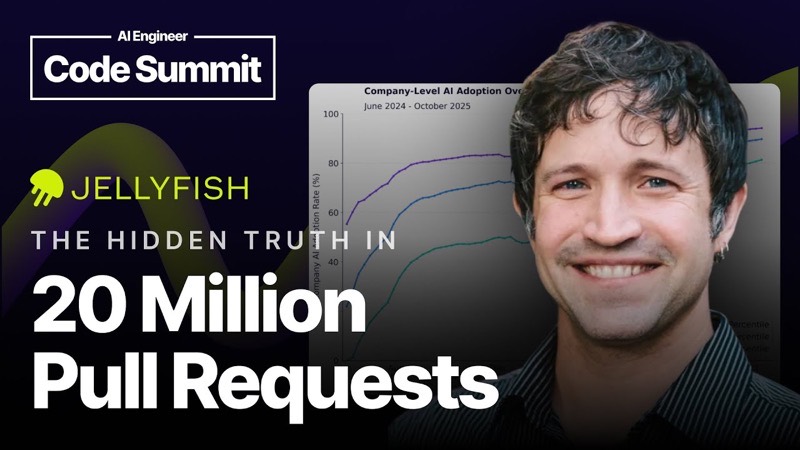
- What Data from 20 Million Pull Requests Reveal About AI TransformationAI Engineer Code Summit · New York · 2025-11
panels
- AI Engineering Trends: Research PanelJellyfish AI Impact Week · 2026-10
- AI in SDLC: Executive Panel & Hands-on WorkshopAWS · Boston · 2026-07
- Leaders on AI's Impact on the Development Life CycleAWS · Los Angeles · 2026-06
- From Copilots to Agents: The New Era of Software DeliveryJellyfish & Pillar VC · Boston · 2026-03
- AI in Action: Modernizing the SDLCAWS · Palo Alto · 2026-02
show all panels (2 more)
- Hack@Brown PanelBrown University · 2026-02
- AI Benchmarks: What Jellyfish Research Learned from Analyzing 20 Million Pull RequestsJellyfish & Crafted · 2026-01
04 / Podcasts
05 / In the Press
Selected press coverage of my work on AI and software engineering.
- Anthropic Just Launched Tools to Show Companies What Their AI Spending Is BuyingTechCrunch · 2026-10
- Claude Code Bills Hit $252 a Month per Developer as Software Factories Automate Code ProductionR&D World · 2026-10
- Claude Code Exceeds GitHub Copilot for Merging Pull RequestsDevOps.com · 2026-10
- The 8 Software Engineering Metrics AI BrokeLeadDev · 2026-06
- The Token Bill Comes Due: Inside the Industry Scramble to Manage AI's Runaway CostsTechCrunch · 2026-06
show all press (5 more)
- AI "Tokenmaxxing" Fails as a Productivity StrategyBusiness Insider · 2026-05
- The Shift: Productivity, at All CostsLeadDev · 2026-05
- Tokenmaxxing Is Making Developers Less Productive Than They ThinkTechCrunch · 2026-04
- Jellyfish AI Development Study: The Real Sting Has Yet to LandThe New Stack · 2026-03
- AI Coding Boom: More Software Shipped, No Hit to QualityBusiness Insider · 2026-03
06 / Get in Touch
I post regularly on LinkedIn and X about AI and software engineering. I also advise early-stage founders as a founding member of a16z speedrun's Insiders program. For everything else, email is the best way to reach me.
for organizers & press
For speaking invitations, interviews, and press requests, email [email protected]. A high-resolution headshot is available to download.

- Topics: measuring AI’s real impact on engineering productivity · autonomous coding agents, trust, and code review · token economics and the cost of AI · why people and practices matter more than model choice · leading organizations through AI adoption
- Short bio: Nicholas Arcolano, Ph.D., is Chief Scientist at Jellyfish, where he leads research on how AI is changing the way software gets built, drawing on workflow data from 1,300+ companies and more than 100 million pull requests.
- Long bio: Nicholas Arcolano, Ph.D., is Chief Scientist at Jellyfish, where he leads Jellyfish Research. His team studies AI adoption using the largest engineering dataset in the industry, covering 1,300+ companies, roughly 300,000 engineers, and more than 100 million pull requests, and turns its findings into guidance for engineering leaders. His work has been covered by TechCrunch, Business Insider, LeadDev, and The New Stack, and he speaks regularly at events including AI Engineer and PlatformCon. Before Jellyfish, he led data science at TrueMotion and Runkeeper, and spent a decade at MIT Lincoln Laboratory researching statistical and machine learning methods. He holds a Ph.D. in applied mathematics from Harvard University and is a founding member of a16z speedrun’s Insiders program.